
After 3 years of work and testing, it is time to provide an update on the 9 demo cases of Seamless-PV and how the solutions implemented can transform the way of doing Integrated PV. We will start with the integration of PV in buildings (BIPV).
BIPV, architecting the active envelope
Modern urban strategy requires the transformation of the “building envelope” from a passive shield into an active power plant. This transition must be achieved without compromising architectural integrity or increasing the complexity of installation. Within the SEAMLESS-PV framework, five demonstration cases validate how modular manufacturing solves distinct design and logistical challenges.
Overcoming Aesthetics, logistics and handling constraints
In residential retrofitting, the cost of labor and heavy machinery often outweighs the benefit of solar integration. Demo 1 (Italy), a residential retrofit in Sesto Fiorentino, addresses this through ergonomic design. By capping the weight of the 1m x 1m glass-glass modules at 30kg, the project enables manual handling and installation. These modules utilize a specialized dark grey interlayer to maintain a high aesthetic value suitable for metropolitan environments while delivering an installed power of approximately 26 kW.

The building subject to the retrofitting
Balancing customization with standardization
Architectural diversity often clashes with manufacturing uniformity. Demo 2 (Switzerland) showcases the synergy between the TeraSlate® Flair and Adapto technologies. While the “Flair” modules provide low-glare, green-colored surfaces to minimize light reflection in sensitive urban areas, the “Adapto” line allows for variable, rectangular dimensions. This modular flexibility ensures that complex facades can be fully covered by an efficient solar skin without the “patchwork” look of traditional panels, reaching a peak power of 27.6 kWp.

Rendering of the PV envelope on the building selected in Switzerland
Performance-driven multifunctionality
Integration is most strategically valuable when it serves multiple technical purposes simultaneously.
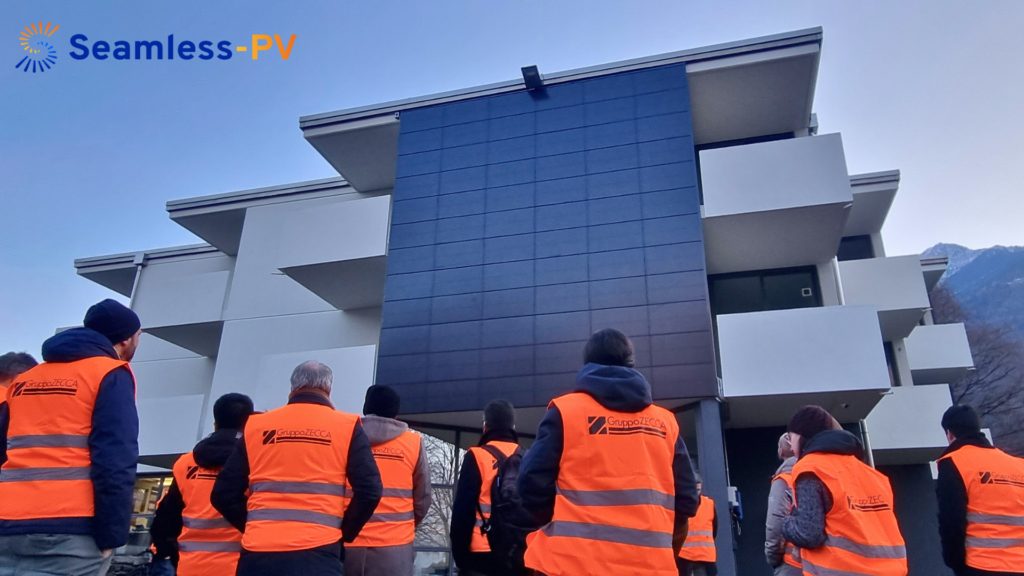
- Demo 3 (Italy): The e-PIZ 54 kit in Cosio Valtellino integrates a PIZ Rock Metabio H54 panel with a 3S glass-glass module. A critical engineering detail here is the use of transparent silicon to bond the 8mm mortar layer to the rear glass of the PV module. This combination provides thermal insulation and a weighted sound reduction index of 13 dB, essentially shielding the office building from noise and heat while generating 20 kWp of power.
- Demo 4 (Belgium): For residential roofing, weight and aesthetics are paramount. This demo utilizes a 2.5kg glass-fiber reinforced composite shingle. By employing Maxeon3 back-contact cells and a “full black” finish, the system achieves 52 Wp per shingle while remaining indistinguishable from traditional black roofing tiles.

The demo in Cosio Valtellino
Validating the Manufacturing Pilot Lines
Demo 5 (France), situated at the FACT building in Le Bourget du Lac, serves as a “versatile laboratory” rather than a mere installation. It validates the project’s flexible pilot lines, specifically the use of pre-packed short strings. The building’s removable claddings allow for the testing of curtain wall designs, proving that manufacturing can adapt PV module sizes to existing architectural dimensions in real-time.
In the next article we will have a look at the other demo cases of Seamless-PV